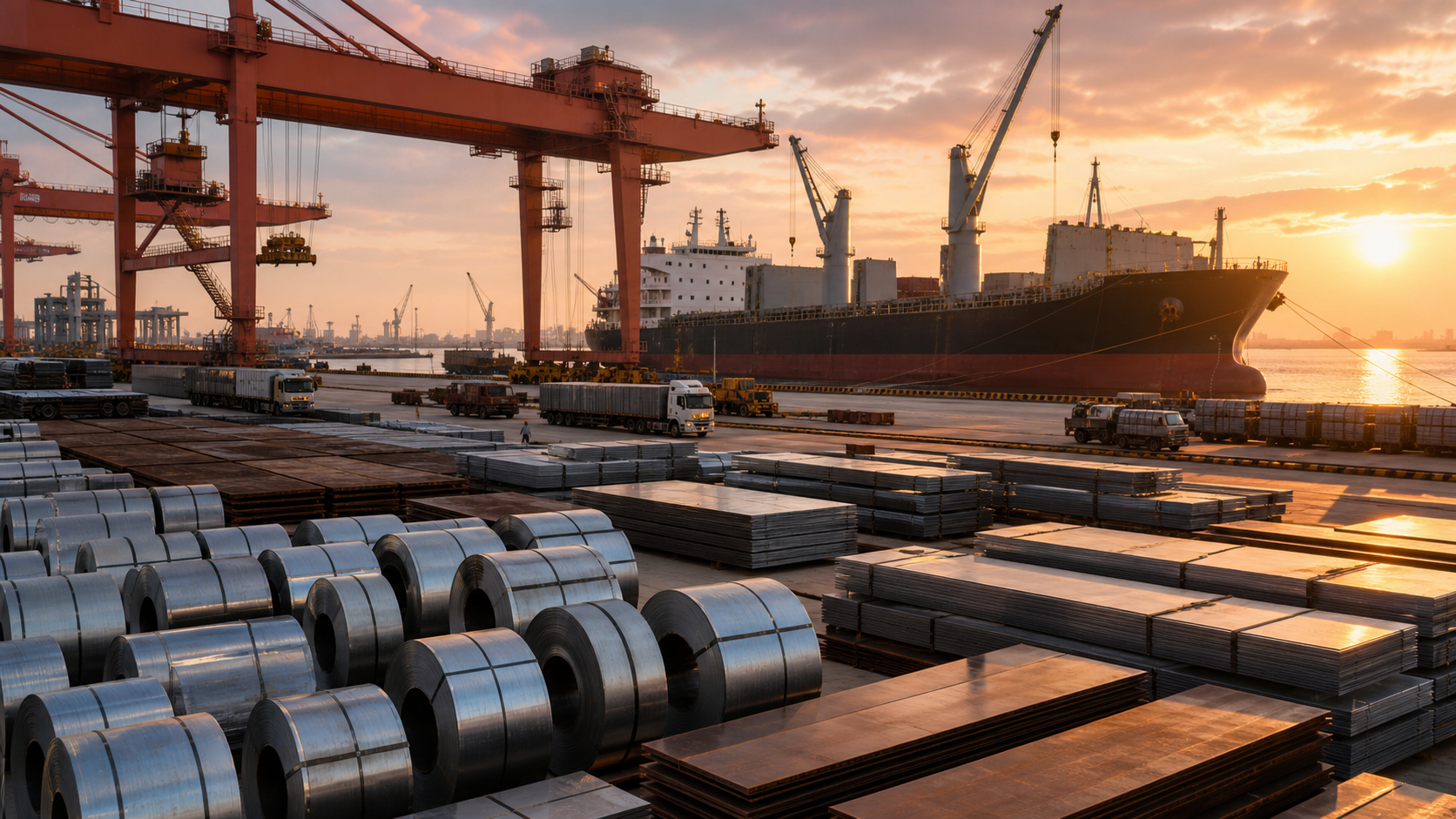
1) Export tonnage is still available, but the mix is changing.
Late-July market coverage suggests China’s steel exports are entering a new phase in which availability matters less than composition. The issue for buyers is no longer whether China can ship steel at all, but which products can still hold margin once freight, compliance, and destination competition are included.
That tends to favor finished steel with clearer downstream use. Coils, plate, and sections connected to visible fabrication or manufacturing demand are easier to price and defend than broad tonnage that relies only on headline offer competitiveness.
2) Trade friction is raising the cost of undifferentiated orders.
A second late-July signal comes from the trade side. Reporting on U.S. pressure for Mexico to mirror tougher steel barriers on China shows that policy friction is still spreading through adjacent markets, even where direct restrictions are not yet uniform.
For exporters and importers, that means weakly specified cargo faces a higher penalty. Buyers are more likely to favor orders with narrower specifications, cleaner paperwork, and clearer destination logic because those orders are easier to reroute or defend if policy conditions change during execution.
3) Softer construction demand is screening finished-steel buying.
Domestic demand signals are reinforcing that selectivity. Recent coverage on China’s 2026 steel outlook points to another year of weaker construction consumption, with the property slump offsetting part of the support coming from manufacturing and infrastructure.
That matters for export business because softer local construction demand does not automatically create easy foreign volume. Instead, it pushes mills and traders to prioritize exportable finished steel that can move against real projects, manufacturing schedules, or fabrication restocking rather than speculative booking.
4) The cleanest buying window is still tied to project-ready demand.
Put together, the late-July picture is not bearish so much as narrower. China can still supply export steel, but the cleanest business is increasingly concentrated in products that satisfy three tests at once: defensible end use, manageable trade exposure, and practical shipment execution.
For YQ Steel buyers, the takeaway is straightforward: move early on finished-steel orders that are linked to genuine project or production demand, and avoid treating all export offers as equally workable. In the current market, order quality is becoming more important than simple tonnage access.