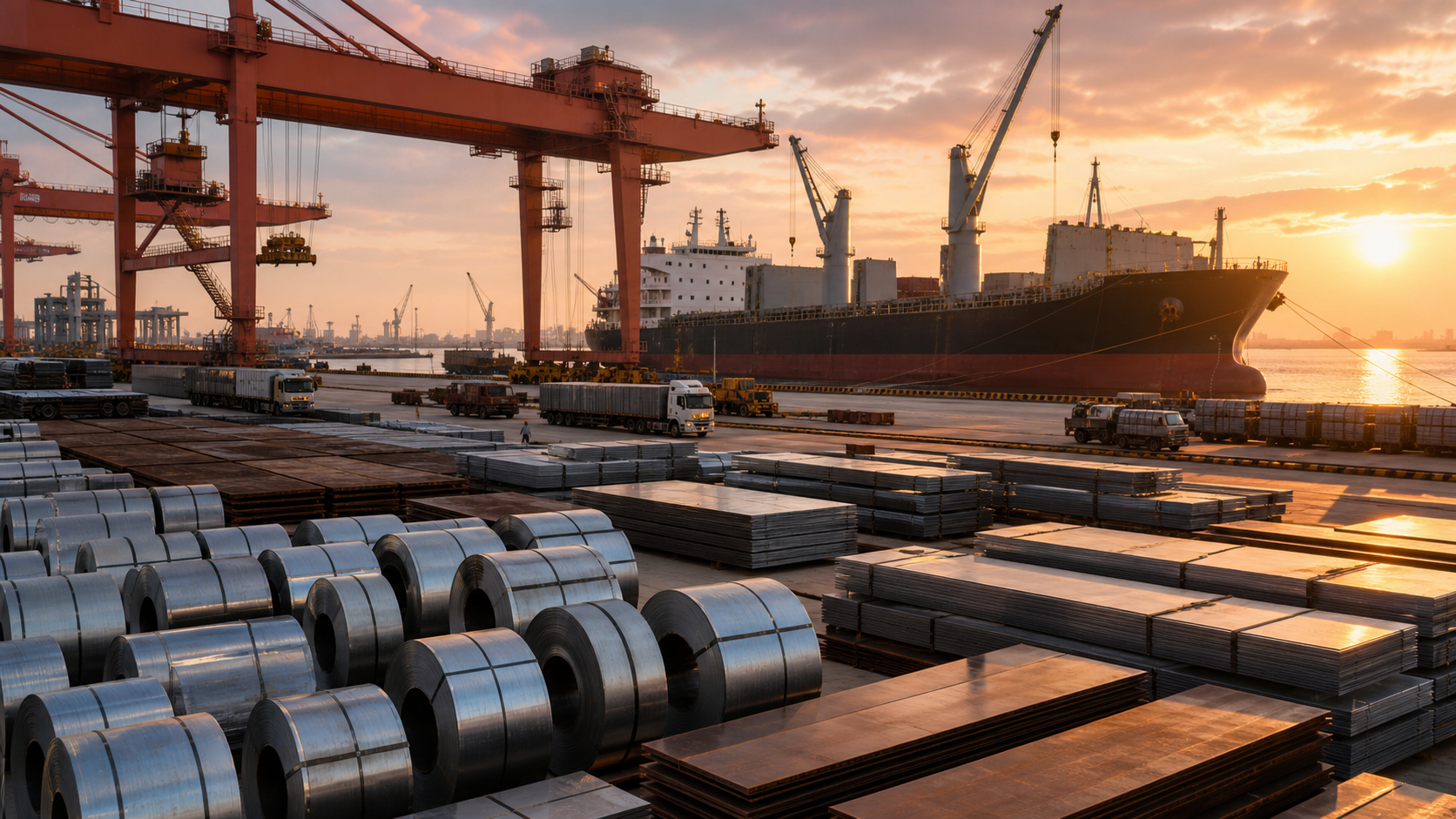
1) H1 export totals still support business, but they also show a market that is screening harder.
SteelOrbis reported that China's finished steel exports reached 54.874 million mt in January through June, down 5.6 percent year on year, while June itself stayed comparatively firm. That combination matters because it says export business remains active, but not broad enough for buyers to treat every offer as equally workable.
In this kind of market, mills can still move volume, yet buyers become more selective about which orders deserve freight, financing, and downstream commitment. The orders that survive usually have a clearer end-use story and a cleaner finished-steel fit.
2) Seaborne flow is thinner, so execution quality becomes part of the product.
AXSMarine's Q2 2026 steel-chain review said global seaborne bulk steel flows fell 7.5 percent year on year to 64.1 million tonnes, even as China was the only one of the four largest exporters to record shipment growth. That makes Chinese cargo more visible inside a softer overall shipping backdrop.
When global flow is thinner, buyers place more value on cargo that can move through port allocation, vessel planning, and document handoff without rework. Freight execution stops being a back-office detail and starts functioning like a quality filter on the sale itself.
3) Trade friction keeps rewarding a narrower, more defensible product mix.
The OECD's Steel Outlook 2026 reinforces the bigger backdrop: excess capacity and trade-policy pressure are not disappearing, even if spot opportunities still open up. That means buyers have to think beyond headline price and ask whether a cargo can pass destination scrutiny as well as commercial scrutiny.
In practice, that favors finished steel tied to active fabrication, distribution, or project consumption over speculative tonnage bought only because the offer looks briefly attractive. Product mix discipline is becoming a risk-management tool, not just a margin decision.
4) The late-July winner is the order that clears both the customer test and the port test.
The best China steel orders right now are not necessarily the largest or the cheapest. They are the ones that combine acceptable mill pricing, lower-friction destination logic, and documents that can move cleanly from contract to customs to vessel.
That is why late-July buying is tilting toward pickier finished-steel selection rather than blanket aggression. In today's export market, the strongest order is the one that can be justified twice: once to the end customer, and again to every trade and execution checkpoint between the mill and the ship.