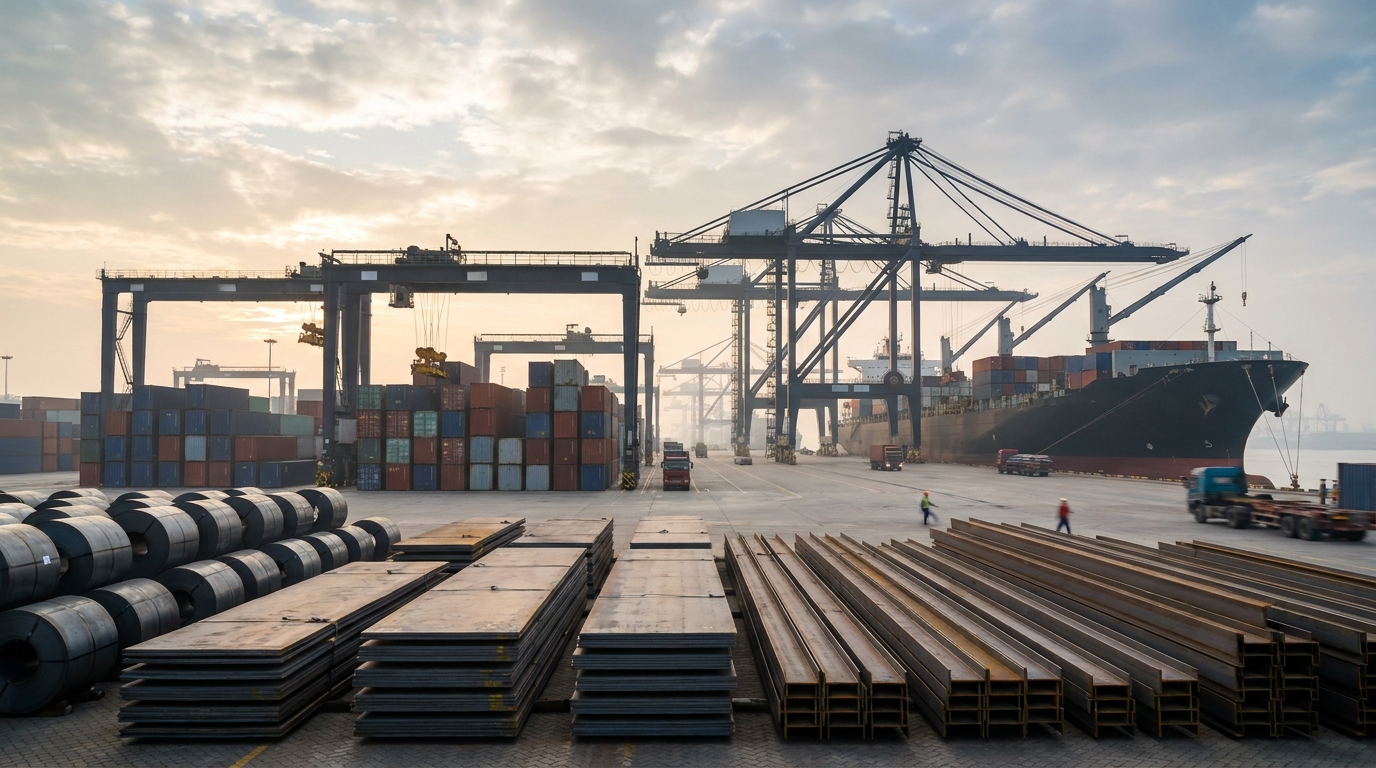
1) H1 exports softened, but June still proved that the market has not shut.
Recent China market reporting citing CISA and customs data showed finished-steel exports at 54.874 million mt in January through June 2026, down 5.6 percent year on year, while June shipments held comparatively firm at roughly 9.68 million mt. That combination matters because it points to selectivity rather than collapse: weaker lanes are fading first, while viable lanes are still taking volume.
For sellers and buyers, the implication is that product mix now needs to be tied to a destination before the quote is treated as real. Hot-rolled coil, plate, galvanized material, and structural sections can still move, but they travel better when the buyer already knows the downstream use, release timing, and import path instead of shopping for tonnage first and solving the rest later.
2) Shipping disruption is turning logistics quality into part of the commercial offer.
Trade coverage around China-linked flows into the Middle East has highlighted how quickly diversions, congestion, and route instability can change the quality of an order after the booking is made. Even when cargo is available and competitively priced, the deal weakens fast if the vessel plan, feeder connection, or discharge-port sequence becomes uncertain.
That is why export execution now starts earlier. Packaging fit, document accuracy, container or breakbulk choice, and realistic loading windows are no longer back-office details. They are part of the value proposition, especially when buyers need steel that can pass from mill allocation to port handling without repeated resets.
3) The cleaner demand signal is a project, not a speculative position.
In a softer export environment, the most reliable finished-steel orders are usually tied to fabrication schedules, contractor replenishment, equipment manufacturing, or maintenance programs with visible consumption timing. Those buyers can accept a narrower lane because they are solving an operating need, not just chasing a temporary arbitrage.
That also changes how Chinese suppliers should frame offers. Instead of presenting the broadest possible volume range, the stronger move is to match grade, thickness, coating, or section size to a project-backed use case and then build the shipping file around that requirement. Cleaner fit reduces both trade-friction exposure and port-side improvisation.
4) The July 18 buyer edge is discipline across destination, documents, and discharge.
The export market still rewards Chinese steel when the order sits inside a lane that can clear policy screens and keep moving physically. That means choosing destinations with less friction, locking the shipping route earlier, and treating execution checkpoints as part of margin protection rather than as post-sale administration.
The practical takeaway for today is simple: China steel exports have narrowed into fewer, cleaner lanes, not vanished. Buyers who connect product mix to real demand and port execution will keep finding workable business, while loosely targeted cargo is more likely to lose time, certainty, and landed-cost control.